

A beautiful website nobody can find is an expensive business card.
First: who builds a website?
- Front end: what you see. Layout, buttons, text, colours, and how the site behaves on a phone.
- Back end: what you don't see. Servers, databases, logins, contact forms, payments and security.
- Full stack: one developer who builds both sides and connects them.
Think of it as a shop. The front end is the shopfront, the shelves and the lighting. The back end is the storeroom, the till, the safe and the alarm. And SEO is the signboard on the main road. Without it, nobody knows the shop is there.
What SEO actually is
Search engine optimisation means making your website easy for Google to find, understand and trust. So when someone searches for what you sell, in the area you sell it, your business shows up, without you paying for every click.
How Google works
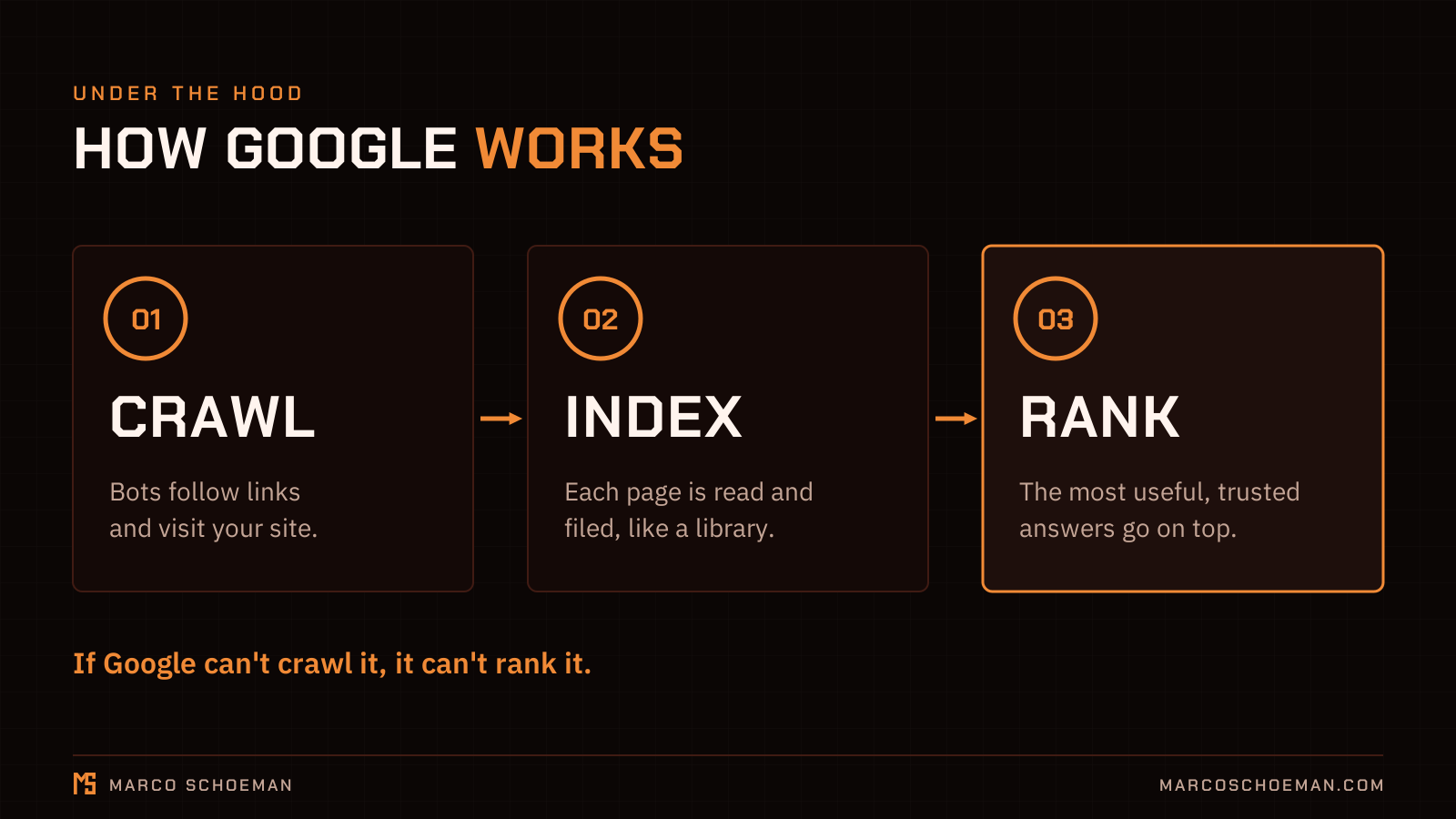
- Crawl: Google's bots follow links from page to page and visit your site.
- Index: Google reads each page and files it, like a librarian with a catalogue.
- Rank: when someone searches, Google picks the most useful, trusted answers and puts them in order.
If Google can't crawl it, it can't rank it.
Why it matters
- People search first. Before they call, visit or buy, most people Google you.
- Ads stop, SEO stays. Switch off ads and the traffic stops. Good SEO keeps working while you sleep.
- Page one wins. Very few people click through to page two.
- Trust before hello. Showing up high with good reviews builds credibility before you've said a word.
- Local = money. "Near me" searches turn into phone calls, directions and walk-ins.
Pillar 1: Technical SEO (can Google get in?)
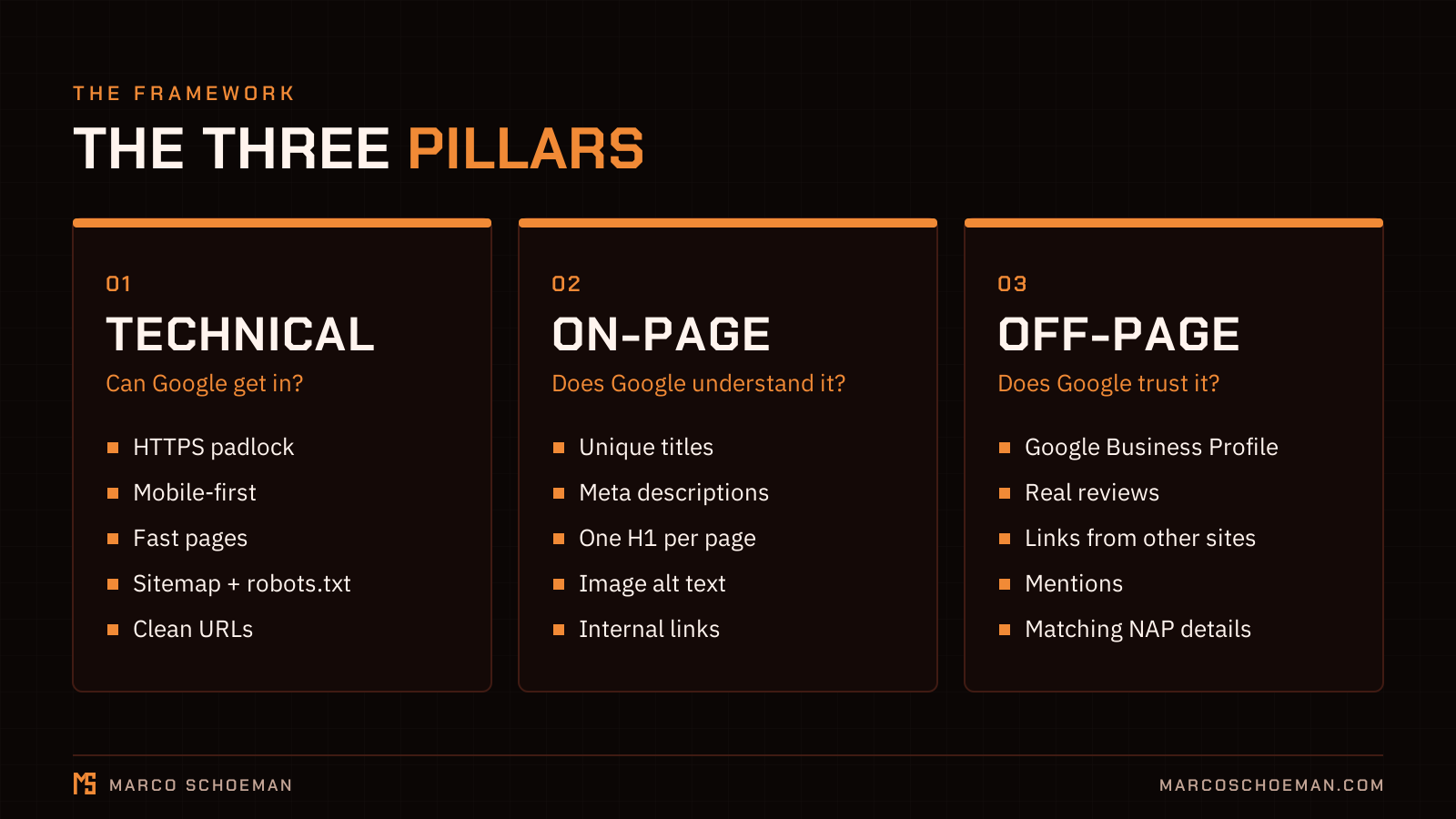
- HTTPS: the padlock. Non-negotiable.
- Mobile-first: Google judges your site on the phone version first.
- Speed: main content within 2.5 seconds, a response to a tap within 200 milliseconds, and nothing jumping around while it loads. Compress images (WebP), lazy-load, use decent hosting, and run fewer plugins. Test it free at PageSpeed Insights.
- XML sitemap: a map of every page, submitted in Google Search Console.
- robots.txt: tells Google what it may and may not crawl.
- Clean URLs:
/services/geyser-repairs, not/page?id=4471. - Schema markup: LocalBusiness data that tells Google your name, address and hours.
Pillar 2: On-page SEO (does Google understand it?)
- Title tag: 50–60 characters. Main keyword, town, brand. Unique on every page.
- Meta description: about 150–160 characters. It's your advert in the search results.
- One H1 per page that says exactly what the page is about, with H2s and H3s breaking it into sections.
- Alt text on every image. Google can't see pictures; it reads them.
- Internal links so Google, and people, can find your other pages.
Then write content that ranks. Give every service its own page. Answer the questions customers ask you on the phone. Use their words: "geyser burst", not "hot water cylinder failure". Say where you are: "Electrician in George" beats "electrical solutions provider". And write for people first; Google rewards pages people actually find useful.
Pillar 3: Off-page and local (does Google trust it?)
Your Google Business Profile is the free listing on Search and Maps, and it's often seen before your website.
Set it up right: claim it at business.google.com, verify it, pick the most specific category, keep your name, address and phone number identical everywhere, add hours (public holidays too), list your services, upload real photos, and link to the right page on your site.
Then keep it alive. Ask every happy customer for a review, reply to every review (calm, short, professional), post updates, and add fresh photos. Never buy or fake reviews; it breaks Google's rules and can get the profile suspended.
Finally, connect the two: the same details on the site and the profile, a contact page with a map embed, and a click-to-call button on mobile.
Mistakes I see all the time
- Keyword stuffing. Google sees it. So do customers.
- Every page titled "Home".
- A 6 MB photo on the home page.
- Zero H1s, or five.
- Different phone numbers in different places.
- Building it once and forgetting it for three years.
Your 7-day plan
- Day 1: Set up Google Search Console and submit your sitemap.
- Day 2: Run PageSpeed Insights and compress your images.
- Day 3: Rewrite your titles and meta descriptions.
- Day 4: One H1 and clear headings on every page.
- Day 5: Claim and verify your Google Business Profile.
- Day 6: Fill in every field and add 10 real photos.
- Day 7: Ask five happy customers for a review.
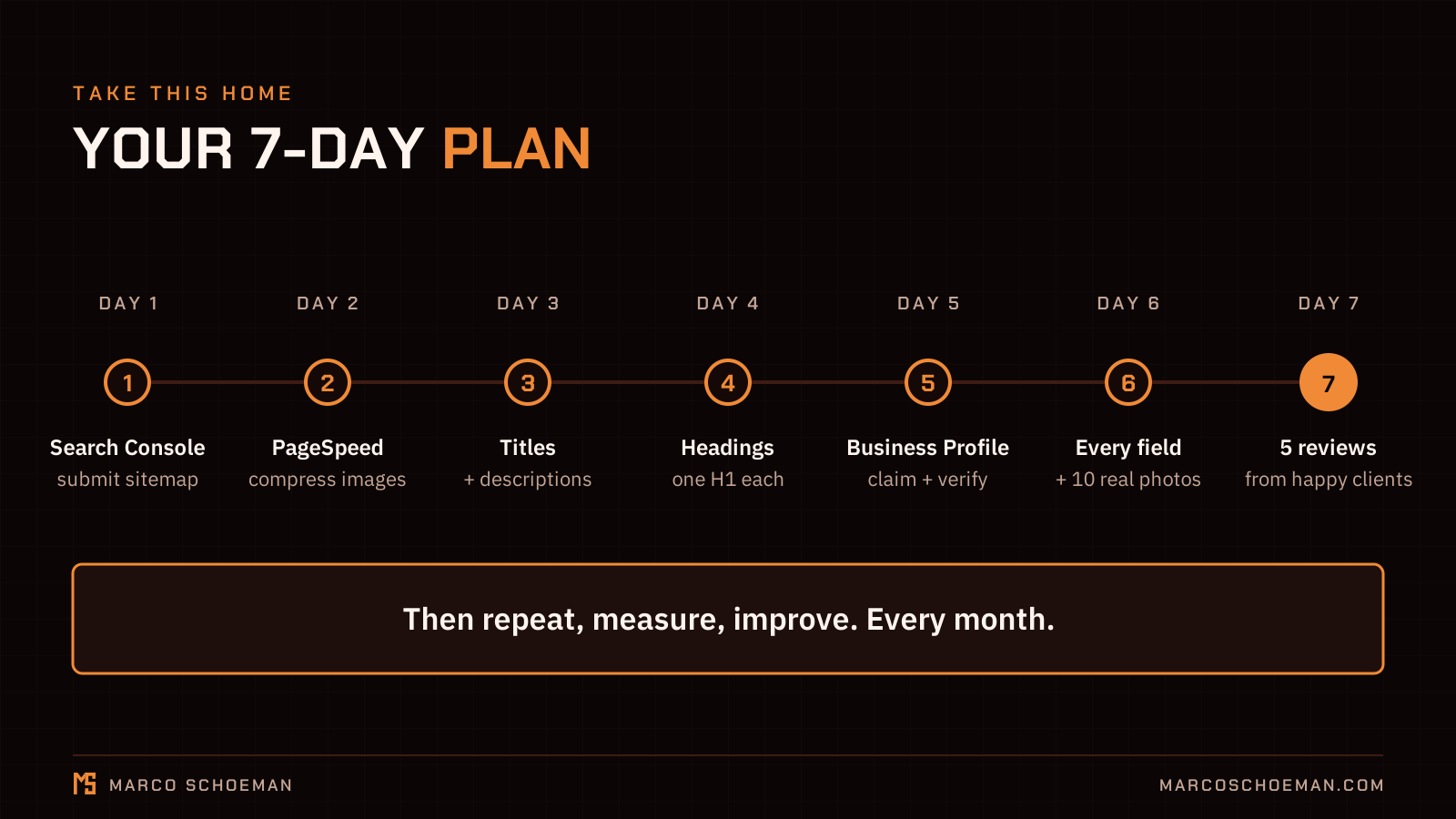
Then repeat, measure and improve, every month.
SEO is not magic. It's maintenance.
General information, not legal or financial advice.

