

Most businesses don't die from no money. They die because nobody wanted the thing.
When a startup dies, the founders often write a post-mortem. CB Insights has collected hundreds of them, and across their updates somewhere between 35 and 42% blame the same thing: no market need. Not the economy. Not the algorithm. Not the competitor with the bigger budget. Nobody wanted it.
So before you spend another rand, run four checks.
1. Your brain is the problem
You love your idea. That's exactly the problem.
There's a thing called the IKEA effect: we overvalue anything we built ourselves. Flat-pack shelf, bit skew, one screw left over, and you'd still defend it in court. Your idea is that shelf.
Everything that follows has one job: get your opinion out of the way, and get the market's opinion in.
2. Market research: stop asking "would you buy it?"
You ask your friends whether they'd buy it. They say yes. Obviously. They like you.
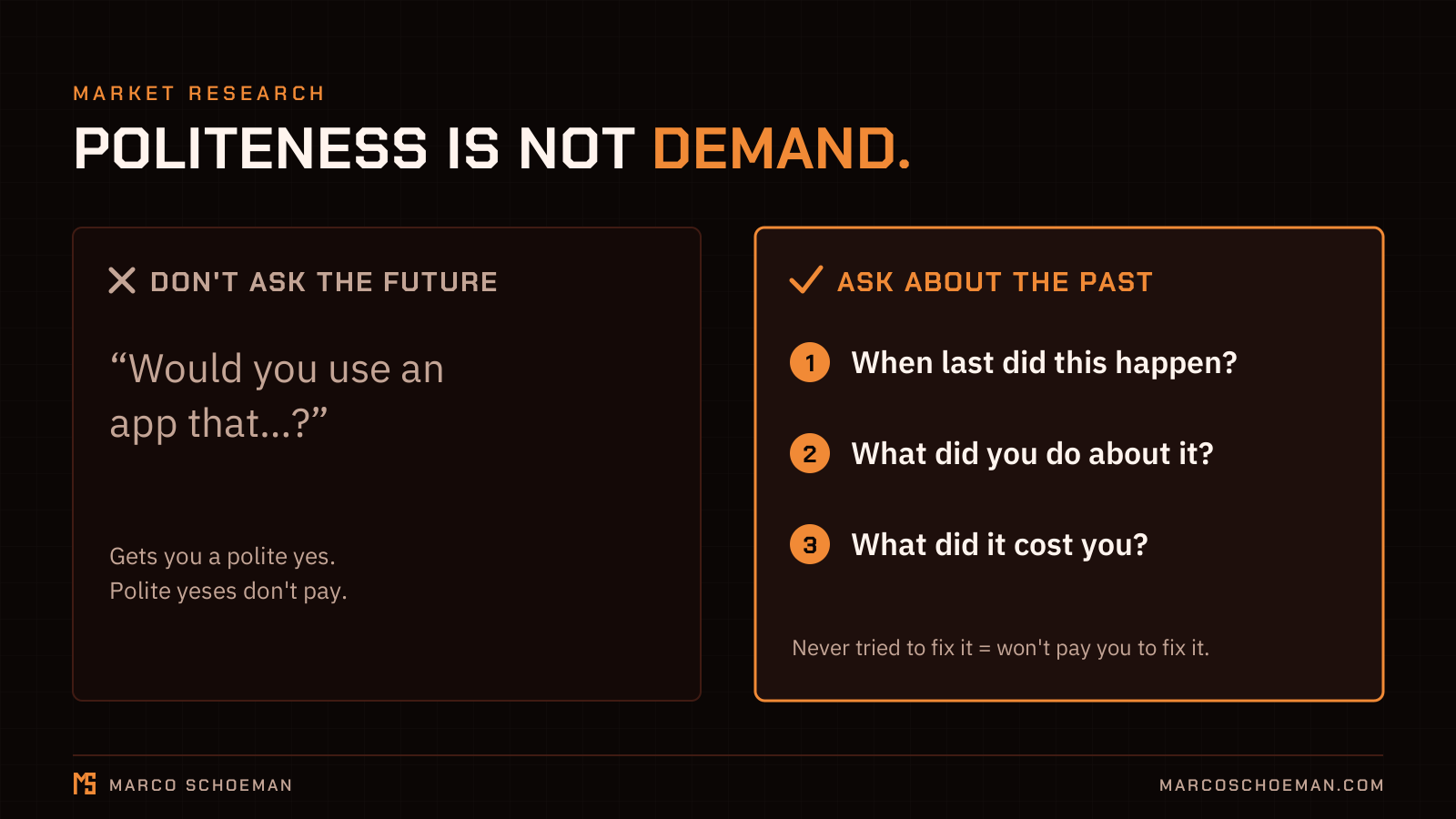
Politeness is not demand.
The rule is simple: ask about the past, never the future.
- Bad: "Would you use an app that…?"
- Good: "When last did you have this problem? What did you do about it? What did it cost you?"
If they've never tried to fix the problem, they won't pay you to fix it.
Free research you can do tonight:
- Competitors' 1–3 star reviews. A list of unmet needs, written by people who already paid.
- TikTok and Reddit. Search the problem and read the comments, not the videos.
- Google Trends. Is interest growing or dying?
- Ten real conversations. With strangers. Not your mother.
If nobody's complaining about the problem, nobody's paying for the solution.
3. Target market: "everyone" is nobody
Ask a new founder who the customer is and you'll usually hear "everyone". Everyone is nobody. You can't afford to reach everyone, and nobody feels spoken to.
Why do we do it? Loss aversion. Picking one customer feels like losing all the others. It's backwards. Narrow is how you get found.
Build one person:
- Who: age, job, town. Specific.
- Pain: what bugs them, in their words.
- Where: the apps, groups and places they already are.
- Money: what they already pay to solve it.
- Trigger: the moment they go looking.
Not "small businesses". A plumber in a small town with two bakkies who sends quotes on WhatsApp at 10pm. Now you know where to find him, what to say, and when to say it.
4. Make the SWOT honest
Most SWOTs are fiction. Twelve strengths, two threats. That's optimism bias, not analysis.
Three rules fix it:
- Every strength needs proof. If a customer didn't say it, it's a wish.
- Inside vs outside. Strengths and weaknesses are things you control. Opportunities and threats are things you don't.
- Do it with a sceptic. Someone who'll disagree with you. Not your co-founder on a good day.
Then turn the boxes into moves:
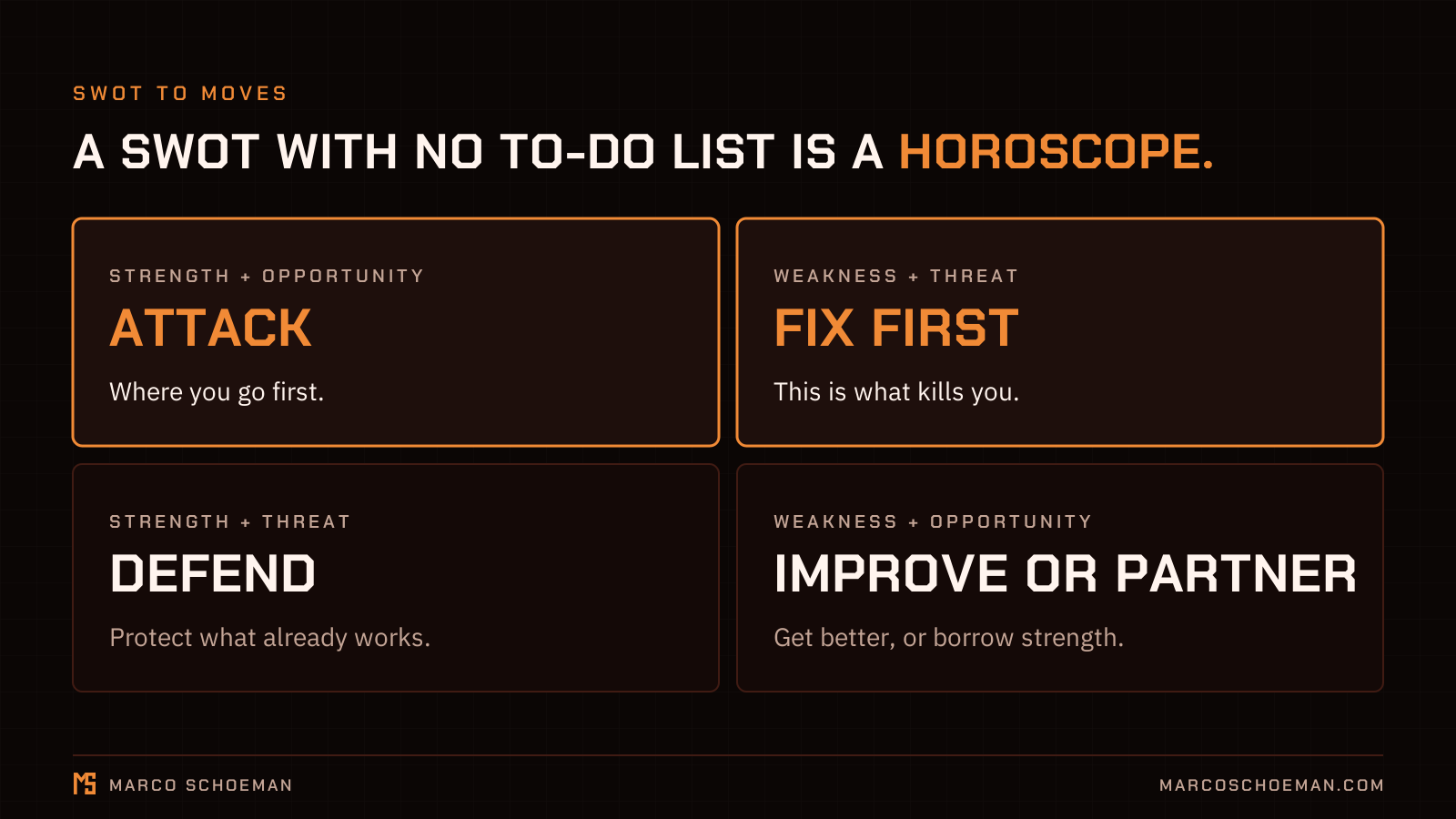
- Strength + Opportunity → Attack. Where you go first.
- Weakness + Threat → Fix first. This is what kills you.
- Strength + Threat → Defend. Protect what already works.
- Weakness + Opportunity → Improve or partner. Get better, or borrow someone's strength.
Every box becomes a task with a name on it. A SWOT with no to-do list is a horoscope.
5. Validate before you build
Wallets don't lie.
Write a one-page offer: what it is, who it's for, and the price. Then pre-sell it with a deposit, a pre-order or a paid pilot. The goal is ten paying people. Not likes. Not a waitlist. Payment.
This is your defence against the sunk-cost trap. The more you spend before you test, the harder it gets to admit it isn't working. If ten strangers won't pay, a logo won't fix it.
The first 30 days
One customer. One offer. One channel. One number.
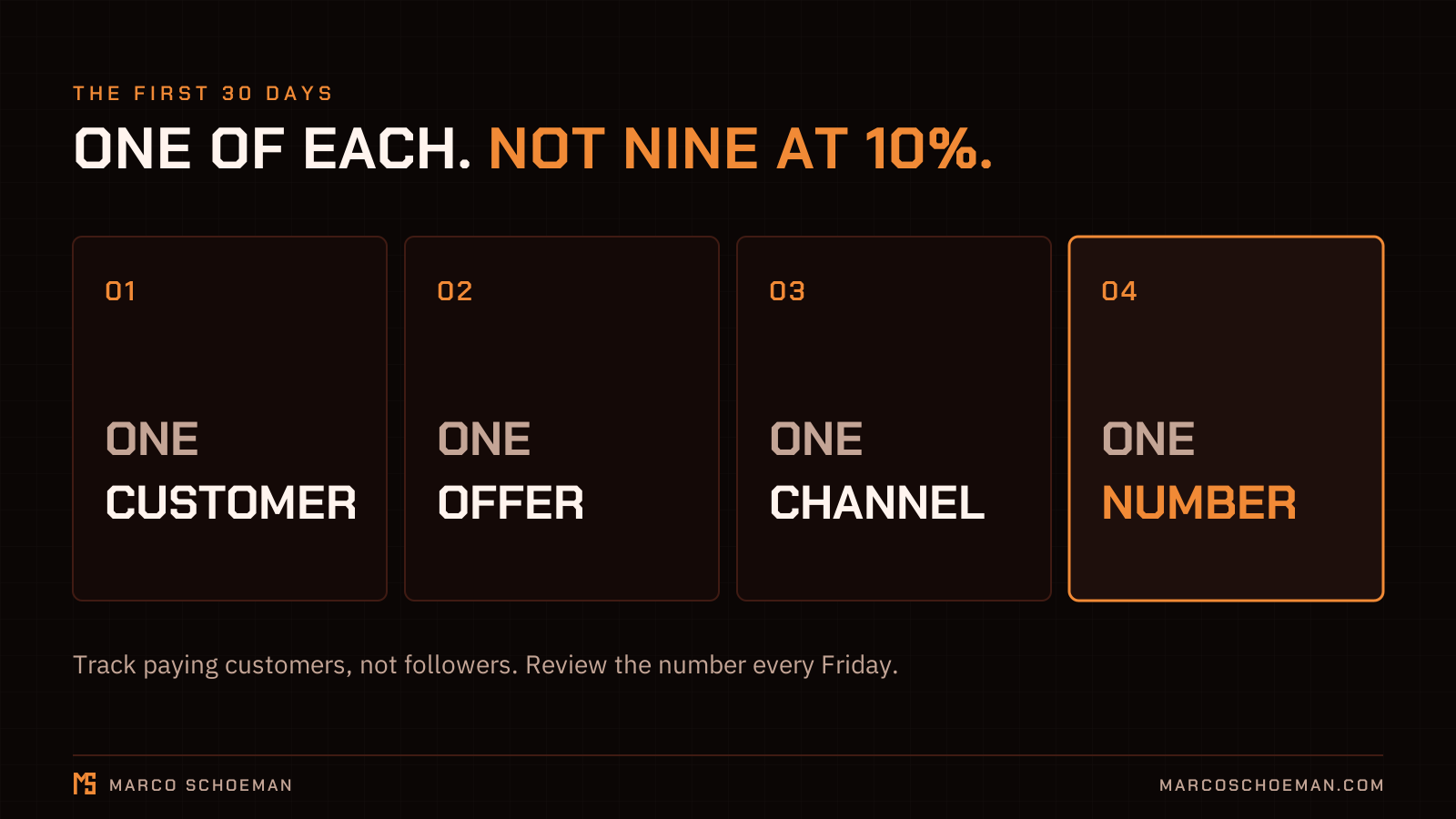
Founders don't fail from doing the wrong thing. They fail from doing nine things at 10%. Track paying customers, not followers, and review the number every Friday.
Your idea isn't the business. The customer is.
Go find ten.
General information, not legal or financial advice.

